
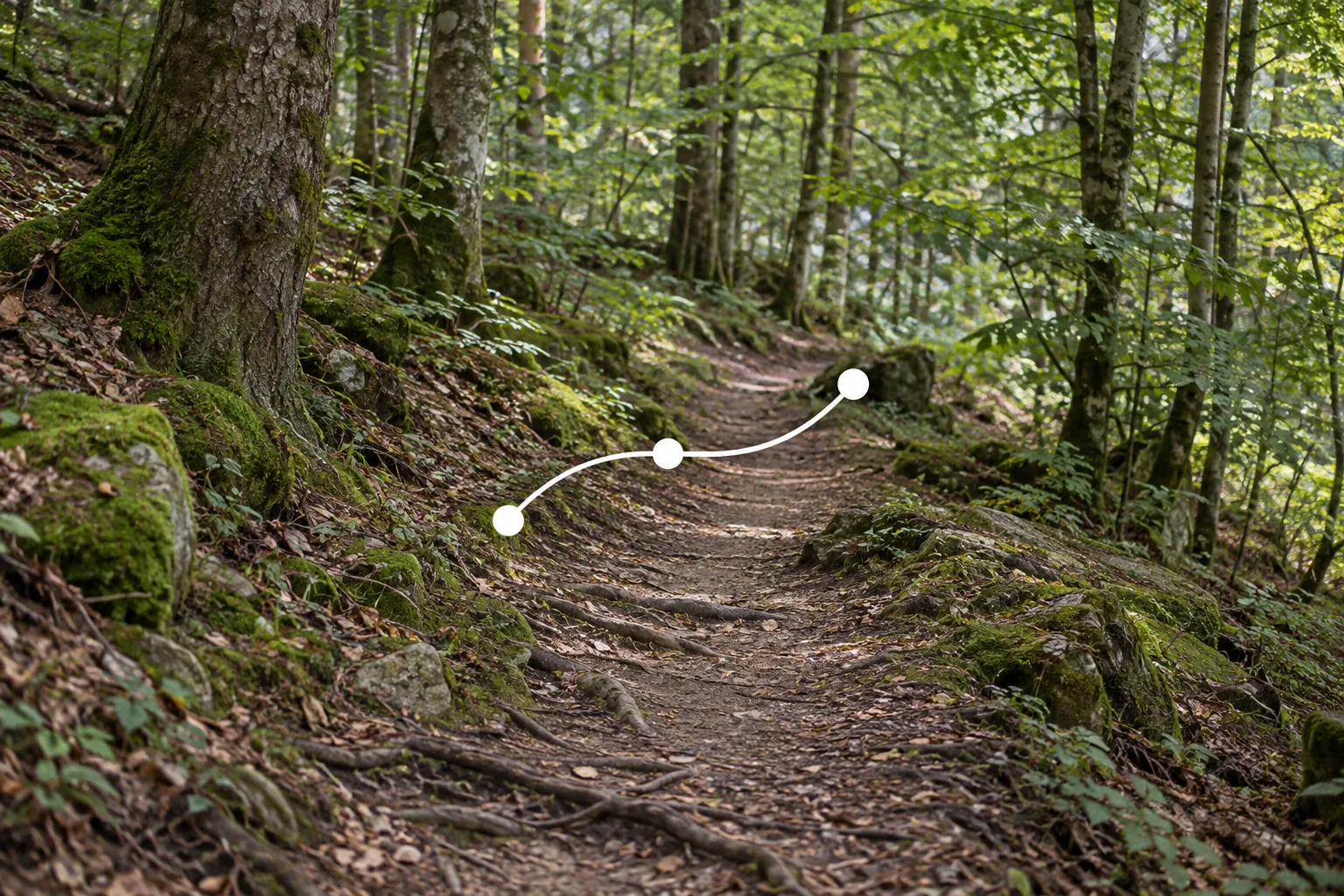
How your brain rewires itself through repetition.
Think about the last time you drove somewhere familiar and arrived with no memory of the drive. Dozens of decisions — mirror, signal, brake, turn — and you weren’t really there for any of them.
That’s a habit, from the inside. Not a strong will. An absent one.
What a habit really is
Early on, a new behavior runs through your prefrontal cortex — the deliberate, effortful, “do I really want to do this?” part of the brain. It’s expensive. It gets tired. It’s the part that loses the argument with the couch.
Repetition moves the behavior somewhere cheaper. Neuroscientists at MIT watching rats learn a maze found that, over many runs, activity in the basal ganglia — a deep, ancient structure — changed shape. Instead of firing the whole way through, it fired at the start and at the end, with quiet in between. The brain had “chunked” the routine into a single unit: cue in, action out, no deliberation required.
That’s what you’re building with every rep. Not willpower. A shortcut.
Why the first reps are the hardest — and the most valuable
The UCL study behind the “66 days” number also produced a curve. Automaticity rose fastest in the early repetitions, then leveled off — every rep still helps, but the first twenty do the heaviest lifting. Which is a strangely encouraging piece of news: the part that feels hardest right now is the part that’s changing you the most.
What makes reps stick
Three things speed this up, and all of them are in your control:
- Same cue. Same time, same place, same trigger. The brain links the behavior to the context, and the context starts doing the remembering for you.
- A clear close. A small, immediate signal that the loop is done — like tapping +1 — gives the brain the “that worked” marker it uses to reinforce the pathway.
- Enough repetitions. Not perfect ones. Enough.